
Live report : OKPAY Connect dévoilé en direct aux associés d’AVI

Ce vendredi 3 juillet, de 19h36 à 20h49, la communauté AVI découvrait en direct OKPAY Connect, la plateforme ivoirienne qui veut connecter Mobile Money, cashback et — demain — le YEM.
Il est un peu plus de 19h30, heure d’Abidjan, quand la salle Zoom se remplit. Ce soir, la réunion des associés d’Afrik Vision Invest (AVI) SARL n’est pas une réunion comme les autres : après des mois de réflexion sur un « modèle ivoirien », un projet longtemps évoqué à demi-mot va enfin être présenté dans son intégralité. Son nom : OKPAY Connect, une plateforme africaine de paiement intelligent.
Nous y étions, carnet de notes ouvert du début à la fin. Voici le récit de cette soirée dense, structuré en trois temps : le contexte qui a fait naître le projet, la présentation elle-même, puis les échanges et les prochaines étapes.
Avant le direct : pourquoi la Côte d’Ivoire cherchait son modèle
Pour comprendre l’enthousiasme de la salle, il faut remonter quelques mois en arrière. Fin 2025, les membres ougandais du réseau lançaient FinFlo, une initiative saluée sur tout le continent, censée s’étendre progressivement à d’autres pays. Mais FinFlo a rencontré un obstacle bien connu : le manque de liquidité, c’est-à-dire la difficulté à convertir rapidement des actifs numériques en argent utilisable au quotidien. Un « nœud gordien », selon les mots employés pendant le direct.
Au Bénin, un leader communautaire a exploré une autre voie : une coopérative où les membres apportent de la liquidité via des packs, puis achètent auprès de marchands partenaires. Même constat partout : sans liquidité et sans commerçants qui acceptent le paiement, aucun système ne tient.
C’est dans ce contexte qu’AVI a mûri une approche propre à la réalité monétaire de la sous-région. Un professionnel ivoirien de la fintech — le terme désigne les technologies appliquées à la finance — a approché AVI avec une idée, peaufinée ensemble : construire d’abord une application de paiement populaire et conforme à la réglementation, puis, une fois la confiance installée, y intégrer le YEM et des stablecoins régulés (des cryptomonnaies conçues pour garder une valeur stable, comme l’USDT ou l’USDC).
19h36 — Ouverture : AVI donne le ton
M. Sorho Vamara Tenena, co-gérant d’AVI SARL, ouvre officiellement la séance au nom du PDG, M. Ouattara. Salutations, remerciements aux associés pour leur engagement, et quelques nouvelles de la maison : AVI vient de souffler sa sixième bougie, un espace web recensant les activités de la structure a été partagé, et chaque associé disposera à terme d’un espace personnel pour suivre ses actifs.
M. Sorho évoque aussi le renforcement du portefeuille d’actifs numériques d’AVI ces derniers mois, avec des justificatifs annoncés dans les groupes. Le message est clair : « On investit, on bâtit le portefeuille pour le bonheur des associés, avec l’ambition qu’AVI compte demain parmi les entreprises qui feront la fierté de la Côte d’Ivoire. »
Puis vient le plat de résistance.
Le cœur du direct : OKPAY Connect, quatre piliers pour un paiement intelligent
OKPAY Connect se présente comme une plateforme africaine de paiement intelligent, avec un slogan qui résume tout : « Connecter les paiements. Sécuriser les intentions. Récompenser chaque transaction. »
Le projet est porté par Honorland SARL, société ivoirienne dirigée par M. Okaingne Akichi Paulin, entouré de deux partenaires : AVI SARL (partenaire investissement, représentant la communauté) et l’African Blockchain Club (ABC) (partenaire stratégique pour la formation et la sensibilisation). Côté technique, les flux financiers passeront par CINETPAY, un agrégateur de paiement — une entreprise agréée qui connecte une application aux réseaux Mobile Money, aux cartes bancaires et aux virements.
💡 À savoir : OKPAY Connect ne se positionne pas comme un service de transfert d’argent entre particuliers, mais comme une infrastructure de paiement numérique opérant avec des partenaires financiers agréés. C’est ce montage qui, selon les porteurs du projet, garantit la conformité réglementaire dès le premier jour.
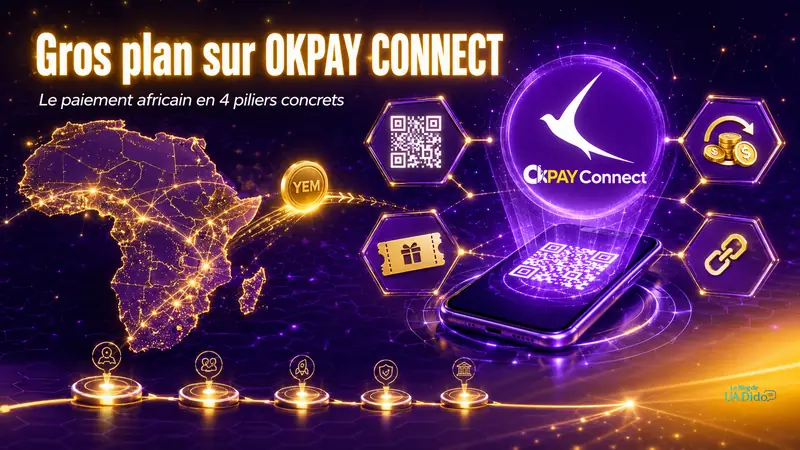
La plateforme repose sur quatre piliers complémentaires :
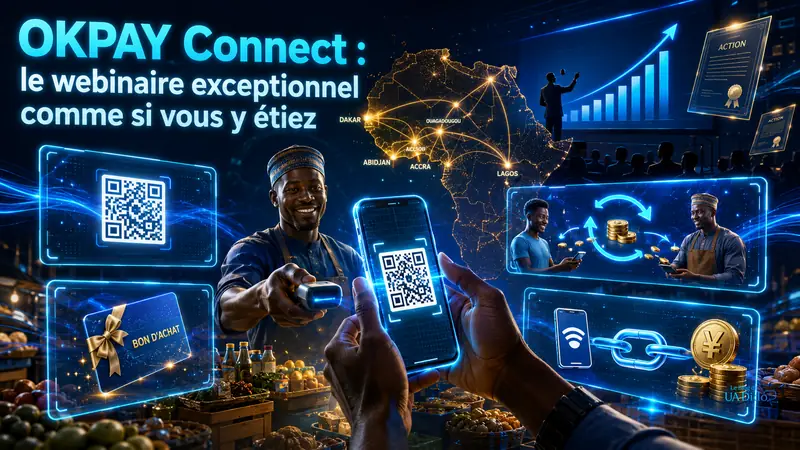
- Connect Pay — le paiement instantané par QR code : on recharge son portefeuille (Mobile Money, carte, virement ou marchand agréé), on scanne le code du commerçant, on valide par code PIN ou empreinte digitale. Quelques secondes suffisent, et les deux parties sont notifiées en temps réel.
- Connect Gift — les bons numériques intelligents. Le Bon Libre est utilisable chez tous les commerçants du réseau ; le Bon Ciblé ne fonctionne que dans les secteurs choisis par son créateur : pharmacies, écoles, supermarchés, stations-service… Pour la diaspora, l’argument a fait mouche : « le bon ciblé transforme un virement en intention garantie ». Les ONG y voient, elles, une traçabilité totale de leurs aides.
- Connect Reward — le cashback partagé, c’est-à-dire un remboursement automatique d’une petite partie du montant à chaque transaction. Originalité du modèle : le client et le commerçant sont récompensés, la plateforme redistribuant une partie de ses commissions.
- Connect Finance — la passerelle financière : Mobile Money, cartes et virements aujourd’hui ; USDT, USDC et YEM demain, dans le respect de la réglementation.

Feuille de route 2026-2030 : la leçon FinFlo retenue
La feuille de route présentée est progressive : lancement en Côte d’Ivoire en 2026 (avec une phase de test réservée aux associés AVI), déploiement national et intégration des actifs numériques — dont le YEM — en 2027 via les API YEMPay, expansion aux huit pays de l’UEMOA en 2028, à l’Afrique francophone en 2029, puis déploiement panafricain en 2030.
Pourquoi ne pas intégrer le YEM dès le lancement ? La réponse donnée en direct est limpide : c’est précisément la leçon tirée de FinFlo. Ouvrir la porte au YEM sans liquidité suffisante exposerait la plateforme à une demande de conversion massive qu’elle ne pourrait pas absorber. La stratégie choisie : bâtir d’abord la confiance, le réseau de commerçants et la liquidité, puis insérer le YEM pour qu’il serve à payer des biens et services réels du quotidien.
Des projections de croissance ont été partagées — jusqu’à 750 000 utilisateurs et 30 000 commerçants à cinq ans. Le pitch deck lui-même les qualifie d’« hypothèses illustratives uniquement — ni promesse ni garantie de rendement ». Nous les rapportons donc comme telles : des ambitions, pas des engagements.

L’ouverture du capital : ce qui a été annoncé
Moment le plus attendu de la soirée : Honorland SARL ouvre 27 % de son capital social à la communauté YEM et aux investisseurs partenaires. Les souscripteurs seraient représentés collectivement par AVI SARL. Valeur nominale annoncée : 10 000 FCFA par part sociale, avec une option de règlement jusqu’à 10 % en YEM, un échelonnement possible sur trois mois à partir de 50 parts, et une période d’acquisition courant du 1er juillet au 30 septembre 2026.
⚠️ Point d’attention : Le Blog de UA Dido rapporte ces modalités telles qu’elles ont été présentées, à titre purement informatif. Ceci n’est ni une offre, ni une recommandation, ni un conseil en investissement. Toute décision d’engagement doit reposer sur votre propre analyse, la consultation des documents officiels auprès d’AVI SARL et, idéalement, l’avis d’un professionnel.
Le promoteur prend la parole
M. Okaingne Akichi Paulin, gérant de Honorland SARL, se présente ensuite : parcours dans la fintech, expérience auprès d’une structure agréée par la BCEAO (la banque centrale des huit pays d’Afrique de l’Ouest utilisant le franc CFA), activité actuelle dans la tokenisation des actifs — la représentation numérique d’actifs réels comme l’immobilier — et l’économie numérique. Détail qui a son importance pour la salle : il est lui-même détenteur de YEM et membre de la communauté.
Son insistance sur un point a marqué le direct : « En Afrique, tout se fait par la réglementation. S’il n’y a pas de réglementation et de faisabilité, on ne peut rien faire. » D’où le choix de CINETPAY comme partenaire technique agréé.
Questions-réponses : la salle s’exprime
Les échanges qui suivent sont nourris. Une première intervention salue le CV du promoteur et pose la question que beaucoup se posaient : l’intégration du YEM en 2027 n’arrivera-t-elle pas trop tard, si la YEM Foundation lance son échangeur avant ?
La réponse de M. Sorho : les deux outils seront complémentaires, pas concurrents. L’échangeur fournira la liquidité (la conversion), tandis qu’OKPAY Connect sera une solution de paiement du quotidien. L’intégration passera par les API YEMPay, conçues exactement pour connecter des plateformes marchandes à la blockchain du YEM. Le promoteur confirme dans le chat.
Le doyen Damien apporte ensuite une contribution remarquée : hommage à l’audace des Ougandais avec FinFlo, salut à la « mentalité d’ouverture » des porteurs ivoiriens qui partagent leur capital, et une conviction : aucune structure ne pourra couvrir seule les besoins du continent — il faudra plusieurs solutions complémentaires. « Lancé tôt ou tard, l’idée sera bénie et nous serons nous-mêmes surpris. »
Après le direct : cap sur la présentation publique
À 20h49, la séance se referme sur des annonces concrètes : le site de promotion (unicornnetwork.ci/okpay-connect/) et le formulaire de souscription partagés dans les groupes, des rencontres régulières à venir, un projet de rencontre physique avec le promoteur et — surtout — une présentation publique à l’ensemble du réseau Unicorn Network dès le week-end suivant. Les associés AVI, qui ont eu la primeur de l’information, sont invités à devenir les ambassadeurs du projet.

Pour aller plus loin
- 🔗 Gros plan sur FinFlo : la plateforme qui veut connecter le YEM au monde réel — pour comprendre le précédent dont OKPAY Connect tire les leçons
- 🔗 Site de promotion des parts sociales d’OKPAY Connect — modalités officielles et formulaire de souscription
- 🌐 Site officiel OKPAY Connect — présentation du projet et informations officielles
- 🌐 CINETPAY, l’agrégateur de paiement partenaire — le partenaire technique des flux financiers
- 🎤 Replay de la présentation Zoom du 3 juillet 2026 — lien à venir dans les groupes de la communauté
Conclusion
Cette soirée du 3 juillet restera comme le moment où la communauté ivoirienne a présenté sa propre réponse au défi du paiement numérique : une plateforme pensée d’abord pour le quotidien — QR code, bons ciblés, cashback — et construite dans le cadre réglementaire, avec le YEM en ligne d’arrivée plutôt qu’en point de départ. La leçon FinFlo a visiblement été méditée.
Reste maintenant l’épreuve du réel : développer l’application, convaincre les commerçants, tenir la feuille de route. La présentation publique au réseau Unicorn Network, annoncée pour le week-end, dira si l’enthousiasme de la salle Zoom se propage au-delà. Nous suivrons chaque étape, comme toujours, avec exigence et bienveillance.
— Signé : Le Blog de UA Dido
This Friday, July 3, from 7:36 pm to 8:49 pm, the AVI community discovered OKPAY Connect live — the Ivorian platform that wants to connect Mobile Money, cashback and, tomorrow, the YEM.
It is just past 7:30 pm, Abidjan time, when the Zoom room fills up. Tonight, the meeting of the associates of Afrik Vision Invest (AVI) SARL is not a meeting like any other: after months of reflection on an « Ivorian model », a project long hinted at is finally being presented in full. Its name: OKPAY Connect, an African smart payment platform.
We were there, notebook open from start to finish. Here is the story of this dense evening, structured in three phases: the context that gave birth to the project, the presentation itself, then the discussions and the next steps.
Before the live: why Côte d’Ivoire was looking for its own model
To understand the enthusiasm in the room, you have to go back a few months. In late 2025, the Ugandan members of the network launched FinFlo, an initiative praised across the continent and expected to expand gradually to other countries. But FinFlo ran into a well-known obstacle: the lack of liquidity — that is, the difficulty of quickly converting digital assets into money usable in everyday life. A « Gordian knot », in the words used during the live session.
In Benin, a community leader explored another path: a cooperative where members bring in liquidity through subscription packs, then purchase goods from partner merchants. The same conclusion everywhere: without liquidity and without merchants who accept the payment, no system holds.
It is in this context that AVI matured an approach suited to the monetary reality of the sub-region. An Ivorian fintech professional — the term refers to technologies applied to finance — approached AVI with an idea, refined together: first build a popular, fully compliant payment application, then, once trust is established, integrate the YEM and regulated stablecoins (cryptocurrencies designed to keep a stable value, such as USDT or USDC).
7:36 pm — Opening: AVI sets the tone
Mr. Sorho Vamara Tenena, co-manager of AVI SARL, officially opens the session on behalf of the CEO, Mr. Ouattara. Greetings, thanks to the associates for their unwavering commitment, and some house news: AVI has just celebrated its sixth anniversary, a website listing the company’s activities will soon be shared, and each associate will eventually have a personal space to track their assets.
Mr. Sorho also mentions the strengthening of AVI’s digital asset portfolio in recent months, with supporting documents to be shared in the groups. The message is clear: « We invest, we build the portfolio for the benefit of the associates, with the ambition that AVI will one day rank among the companies that will make Côte d’Ivoire proud. »
Then comes the main course.
The heart of the session: OKPAY Connect, four pillars for smart payments
OKPAY Connect presents itself as an African smart payment platform, with a slogan that says it all: « Connecting payments. Securing intentions. Rewarding every transaction. »
The project is led by Honorland SARL, an Ivorian company managed by Mr. Okaingne Akichi Paulin, supported by two partners: AVI SARL (investment partner, representing the community) and the African Blockchain Club (ABC) (strategic partner for training and awareness). On the technical side, financial flows will go through CINETPAY, a payment aggregator — a licensed company that connects an application to Mobile Money networks, bank cards and bank transfers.
💡 Good to know: OKPAY Connect does not position itself as a person-to-person money transfer service, but as a digital payment infrastructure operating with licensed financial partners. According to the project leaders, it is this setup that guarantees regulatory compliance from day one.
The platform rests on four complementary pillars:
- Connect Pay — instant payment by QR code: you top up your wallet (Mobile Money, card, bank transfer or approved reload merchant), scan the merchant’s code, and confirm with a PIN code or fingerprint. A few seconds are enough, and both parties are notified in real time.
- Connect Gift — smart digital vouchers. The Open Voucher can be used at any merchant in the network; the Targeted Voucher only works in the sectors chosen by its creator: pharmacies, schools, supermarkets, petrol stations… For the diaspora, the argument hit home: « the targeted voucher turns a money transfer into a guaranteed intention. » NGOs, for their part, see in it full traceability of their aid.
- Connect Reward — shared cashback, i.e. an automatic refund of a small part of the amount on every transaction. The model’s originality: both the customer and the merchant are rewarded, with the platform redistributing part of its commissions.
- Connect Finance — the financial gateway: Mobile Money, cards and bank transfers today; USDT, USDC and YEM tomorrow, in full compliance with regulation.
2026-2030 roadmap: the FinFlo lesson learned
The roadmap presented is progressive: launch in Côte d’Ivoire in 2026 (with a test phase reserved for AVI associates), national rollout and integration of digital assets — including the YEM — in 2027 via the YEMPay APIs, expansion to the eight WAEMU (UEMOA) countries in 2028, to French-speaking Africa in 2029, then full pan-African deployment in 2030.
Why not integrate the YEM from launch? The answer given live is crystal clear: this is precisely the lesson learned from FinFlo. Opening the door to the YEM without sufficient liquidity would expose the platform to a massive conversion demand it could not absorb. The chosen strategy: first build trust, the merchant network and liquidity, then bring in the YEM so that it can be used to pay for real goods and services in everyday life.
Growth projections were shared — up to 750,000 users and 30,000 merchants within five years. The pitch deck itself describes them as « illustrative assumptions only — neither a promise nor a guarantee of returns ». We therefore report them as such: ambitions, not commitments.
The capital opening: what was announced
The most anticipated moment of the evening: Honorland SARL is opening 27% of its share capital to the YEM community and partner investors. Subscribers would be collectively represented by AVI SARL. Announced nominal value: 10,000 FCFA per share, with an option to pay up to 10% in YEM, possible payment in instalments over three months from 50 shares upwards, and an acquisition period running from July 1 to September 30, 2026.
⚠️ Please note: Le Blog de UA Dido reports these terms as they were presented, for information purposes only. This is neither an offer, nor a recommendation, nor investment advice. Any decision to commit must be based on your own analysis, consultation of the official documents with AVI SARL and, ideally, the advice of a professional.
The promoter takes the floor
Mr. Okaingne Akichi Paulin, manager of Honorland SARL, then introduces himself: a career in fintech, experience with a structure licensed by the BCEAO (the central bank of the eight West African countries using the CFA franc), and current activity in asset tokenization — the digital representation of real-world assets such as real estate — and the digital economy. A detail that matters to the room: he is himself a YEM holder and a member of the community.
One point he insisted on marked the session: « In Africa, everything goes through regulation. If there is no regulation and no feasibility, nothing can be done. » Hence the choice of CINETPAY as the licensed technical partner.
Q&A: the room speaks
The discussions that follow are lively. A first contribution praises the promoter’s strong track record and asks the question many were asking: won’t the YEM integration in 2027 come too late, if the YEM Foundation launches its exchanger before then?
Mr. Sorho’s answer: the two tools will be complementary, not competitors. The exchanger will provide liquidity (conversion), while OKPAY Connect will be an everyday payment solution. The integration will go through the YEMPay APIs, designed precisely to connect merchant platforms to the YEM blockchain. The promoter confirms this in the chat.
Elder Damien then makes a notable contribution: a tribute to the boldness of the Ugandans with FinFlo, praise for the « spirit of openness » of the Ivorian project leaders who share their capital, and one conviction: no single structure will be able to cover the continent’s needs alone — several complementary solutions will be necessary. « Launched early or late, the idea will be blessed and we will be surprised ourselves. »
After the live: heading for the public presentation
At 8:49 pm, the session closes with concrete announcements: the official website (okpayconnect.com) and the subscription form shared in the groups, regular meetings to come, a planned in-person meeting with the promoter and — above all — a public presentation to the entire Unicorn Network community the following weekend. The AVI associates, who got the information first, are invited to become the project’s ambassadors.
Going further
- 🔗 Spotlight on FinFlo: the platform that wants to connect the YEM to the real world — to understand the precedent OKPAY Connect learns from (in French)
- 🔗 OKPAY Connect share subscription page — official terms and subscription form
- 🌐 OKPAY Connect official website — project presentation and official information
- 🌐 CINETPAY, the partner payment aggregator — the technical partner for financial flows
- 🎤 Replay of the July 3, 2026 Zoom presentation — link coming soon in the community groups
Conclusion
This evening of July 3 will be remembered as the moment when the Ivorian community presented its own answer to the digital payment challenge: a platform designed first for everyday life — QR codes, targeted vouchers, cashback — and built within the regulatory framework, with the YEM as the finish line rather than the starting point. The FinFlo lesson has clearly been taken to heart.
Now comes the test of reality: developing the application, convincing merchants, keeping to the roadmap. The public presentation to the Unicorn Network community, announced for the weekend, will tell whether the enthusiasm of the Zoom room spreads beyond it. We will follow every step, as always, with rigor and goodwill.
— Signed: Le Blog de UA Dido
YEM débutant paiement Côte d'Ivoire live report OKPAY Connect
La série live report
Article 9 sur 29 de la série
Sur les mêmes sujets
Lié par : OKPAY Connect, paiement
Lié par : OKPAY Connect, paiement
Lié par : paiement, YEM

Commentaires
Pour commenter, connectez-vous ou créez un compte gratuit.
Se connecter · Créer un compte